Use headlines instead of tables
If a picture paints a thousand words, how many words does a table of data save?
However, a table is a wasted opportunity if the reader skips over it.
I have a tip to make the tables in your documents have more impact?
If a picture paints a thousand words, how many words does a table of data save?
However, a table is a wasted opportunity if the reader skips over it. I have a tip to make the tables in your documents have more impact?
As accountants we often want to include tables in our documents, to summarise the data we are writing about. There are lots of things we can do to help the reader to get the right message (i.e. the one we want them to get) from a table of data.
My first tip for doing this is to give every table a title. Put some thought into the title. It is natural perhaps to use a factual title. Something like: revenue analysis YTD (YTD is year-to-date, for any non-accountant readers). A factual title is, I suppose, better than no title, but not much better.
Instead, give your table a title that tells the reader what they should be looking for in it. Think of it more like a headline than a heading. So, instead of revenue analysis YTD you might use: revenue is up 10% over last year. By doing this you make it easier for the reader to interpret the table and you also reinforce the message you are (presumably) making in the text.
TL;DR
Don’t give titles to your tables; give them headlines.

Learn to see the invisibles
Learn how to show the invisible, non-printing formatting characters so that you can fix layout problems in your documents.
Here’s the first of what I expect will be very many posts with tips on using Microsoft Word (and many of them will be directly useful in other word-processing apps like Google Docs and Apple’s Pages).
Once you have got all the right words and numbers in the right order you still need to make them look neat and tidy on the page/screen. The default option in Word is not to show the formatting marks that would not be printed or displayed if the document were converted to a PDF. These marks show the space and tab characters, page and section breaks and where paragraphs end.
I recommend you toggle the setting to show the formatting marks so that you can fix places where the words, numbers or tables are not displaying in the way you want.
It’s easy to do. On the Home toolbar there is a button with what looks like a backward P on it (the symbol is called a pilcrow). Click that to toggle the formatting marks on and off. If you use Apple Pages the Show/Hide Invisibles is in the View menu (or use the shortcut Shift+Cmd+I).

Toggle the formatting marks on and you will see where there are multiple spaces instead of single spaces and where multiple carriage returns have been used to force a line onto a new page instead of using the page break command and so on.
If you find the formatting marks to be obtrusive when you are actually writing you can turn them off and then turn back on when you want to check the document’s format and layout.
PS. Google Docs does not do this natively. You can install an add-on to do it which is, I think, not great-looking and does not update as you type. If you want to know how to install this send me a message and I’ll explain.
Email productivity hacks for accountants
My previous post explained some productivity hacks for writing. This post has three hacks to help you manage your email efficiently.
My previous post explained some productivity hacks for writing. This post has three hacks to help you manage your email efficiently.
Close your mail app

Whatever app you use for your email keep it closed except for the specific times you actually want to read and reply to messages. Doing this cuts out all the notifications.
The problem with an always-open email app is the risk that when you go to it you get sucked into reading and replying to messages when you have more important or more urgent thing to do.
I suggest you set yourself specific times when you will do your email, say 30 minutes in the morning and 30 minutes towards the end of the day.
If an email can be dealt with quickly, whether that is to delete it, archive it or write a short reply, do it straightaway. If an email needs a longer response, record it as a task in your todo list.
Filter your mail

Use the power of your email app to process some (most) of your messages for you. Some of the filter rules I use are:
messages from people connected with a charity I volunteer for go into a separate folder, marked as read
I assume that messages that are copied to me are not urgent and therefore if my name is not in the ‘To’ field then the message is marked as read and moved into a folder called “Copied to me”. I rarely look in that folder.
any message with the word unsubscribe in it is marked as read and moved into a “Newsletter” folder. I look through them occasionally to see if there is anything I want to read.
You could do more. You could identify messages from certain people, such as your line manager, and add a colour to them so they stand out. You could send all messages with unsubscribe direct to the trash.
Each mail app will do filtering in a different way so you will need to research how to create the filtering rules for your particular app.
Search the archive

Aside from the folders above that I created as destinations for incoming messages I do not want in my Inbox but do not want to auto-archive, I have only one folder, the Archive. When I have dealt with a message I either delete it (my preference) or send it to Archive. This is also true of the messages filtered out by rules described above.
I do not structure my folders. I rely on the mail applications search feature to find anything I need in the future. Even with 15,000 messages (I just checked), the search feature is fast and I can do it on my phone, a tablet or my computer.
To search for a message means I need to know something about it (the sender, a keyword or phrase, a date) but that is all I need: I do not also need to know where I would have filed it. Sometimes I cannot find what I am looking for. The chances are that is because I have deleted it. I am confident that I would have fared no better if I had structured folders and at least I save the time spent creating and maintaining such folders.
Do you have any tips or hacks to share?
Let me know your productivity tips and perhaps I could include them in a future post.

Productivity hacks for accountants
This is the first of what may become a series of posts about productivity.
There are countless podcasts, articles, and blogs about productivity. I’m a listener/reader of some and I don’t think I have ever come across one specifically made or written with accountants in mind.
Allow me to step into that gap with (my first) three tips that I think can be adopted by accountants regardless of the technology they are given to use by their organisation.
This is the first of what may become a series of posts about productivity.
There are countless podcasts, articles, and blogs about productivity. I’m a listener/reader of some and I don’t think I have ever come across one specifically made or written with accountants in mind.
Allow me to step into that gap with (my first) three tips that I think can be adopted by accountants regardless of the technology they are given to use by their organisation.
Use keyboard shortcuts
Navigating documents and spreadsheets is quicker using the arrow keys than using a mouse or trackpad. There are shortcuts for most of the popular actions such as copy (Cmd/Ctrl + C), paste (Cmd/Ctrl + V), save (Cmd/Ctrl + S), and open (Cmd/Ctrl + O). In Word the space bar combined with arrow keys highlights text faster than you can drag a mouse
You can see the shortcuts next to the items in the menus in apps like Word, Excel, and PowerPoint. You could also do a web search for lists of shortcuts
Don’t try to learn every shortcut in one go; instead, learn one or two and when they become second nature learn another couple.
Use text expansion
There must be some phrases, sentences, and even paragraphs that you use over and again. This could be contact info like your email address and phone number. It could be a standard reply to email requests. Whenever you notice you are writing something you have written before, or you find yourself looking for a previous document to copy the text for re-use, there is a candidate for text expansion.
Text expansion is a service where you link a short trigger phrase to a longer one so that when you type the trigger phrase it is replaced by the longer phrase. For example, when I type ‘socf’ it is replaced by statement of cash flows and ‘xbs’ is replaced by balance sheet. (I use x as the first letter for lots of my triggers because few real words begin with an x and it is on the main keyboard so takes fewer taps on a phone or tablet.)
I also use text expansion for auto-correction of words. For example, when I type ‘cipfa’ it will automatically be capitalised to CIPFA.
There are many text expansion apps available and which suits you depends in part on the device you have and how much you are willing to pay to save time. Textexpander is the one I have. It works across platforms and can be synced so that the same trigger shortcuts are available on all your devices.
Bonus tip
If you use an Apple computer, an iPhone, or iPad then you can do you text expansion for free because Apple has built it into the operating systems. Go to the Keyboard section of settings to set it up.
Use your voice
When I was a finance director in the early 2000s I had a voice recorder and a personal assistant, Lynn. I could, and did, talk into my voice recorder when walking to and from the office and give the tapes to Lynn to turn into letters, emails, reports, etc. Lynn would sometimes have time to type things for other members of staff but most of the staff, most of the time, had to write their own documents.
These days we can all dictate our writing using just a smartphone and I strongly recommend that you do. I am sure you can speak faster than you can type. Voice recognition software has improved over the years and it makes fewer mistakes out-of-the-box and the more you use it the better it gets as it learns the words you use.
I suggest next time you have a document to write that is more than 2 or 3 paragraphs long you try dictating the first draft on your phone. Email that document to your work account so that you can put the words into the official template and then finish the document. I think you could save a stack of time and effort.
Let me know your productivity tips and perhaps I will include them in a future post.

Talking is a lot easier than typing
This tip is only for accountants with iPhones, iPads or Apple Watches (sorry if that’s not you). Some people are very fast, very accurate typists but most of us are not. I for one, and I suspect most readers of this, can think and speak much faster than I can type. So why type long emails, letters and reports if you can dictate them?
This tip is only for accountants with iPhones, iPads or Apple Watches (sorry if that’s not you). Some people are very fast, very accurate typists but most of us are not. I for one, and I suspect most readers of this, can think and speak much faster than I can type. So why type long emails, letters and reports if you can dictate them?
The in-built keyboard on an iPhone has a microphone button which toggles into dictation mode and what you say is transcribed. This transcription gets better over time as Siri learns about the technical words you use but there is one annoying limitation. After about 45 seconds the transcription stops and you have to select the microphone button again. This is not a problem if you want only to dictate one or two sentences in an email reply, or send a quick text to your significant other, but it gets in the way of longer dictation sessions.
Recently I discovered an app called Just Press Record which does not have this limitation. You press its record button, speak and it both saves a recording of your voice and creates a transcription of it, a transcription which is editable. Once you’ve finished a recording and transcription you can share them separately or together. This means you email the text to someone, open it in one of the other text apps on your phone, save it as a file or copy the text to the clipboard and paste into an app. This app is handy for capturing quick notes and fleeting ideas as well as longer sections of prose. You could record a whole report in one single speech — I would be impressed by anyone with that level of skill — but the app needs to be the foreground app during transcription which would stop you moving on to do something else. Realistically, then, the app is better used by recording a longer document section by section, and assembling the transcriptions into the full document afterwards.
The app is £4.99 in the UK ($4.99 in the US) and worth checking out on the App Store*. This is a great deal compared to the online transcription services that charge something like $1 a minute to transcribe a recording. Not only that, the recording and transcription is done on your phone so you’re not at risk of someone stealing your recordings, etc.
All in all, I think you could very quickly get a fiver’s worth of value from it. I certainly have.

* There are no affiliate links here. I'm just giving you my personal opinion.

Grammarly can improve your writing wherever you write
Grammarly is a major improvement on the grammar checker built into your word processor because it works on writing everywhere. You can check emails, text messages, Facebook and LinkedIn posts, etc.
Recently I wrote a post that mentioned Hemingway as a web service that could help you improve the readability of the reports, letters and other documents you write. Today I am recommending another online resource: Grammarly.
You’re likely familiar with the spelling and grammar checker built into your word processor. They are useful enough but Grammarly is a major improvement because it works on writing outside of your word processor.
It can do this because it is a web-based service. There are browser extensions for the major browsers so that it can work on G-mail or any other browser-based email, it can work in communication services like Slack, in social media like FaceBook and LinkedIn, and so on. If you want to write your document in Word or Pages or some other application you can copy the text, paste it into the Grammarly window and have Grammarly check it for you. See below an early draft of this post inside of Grammarly.
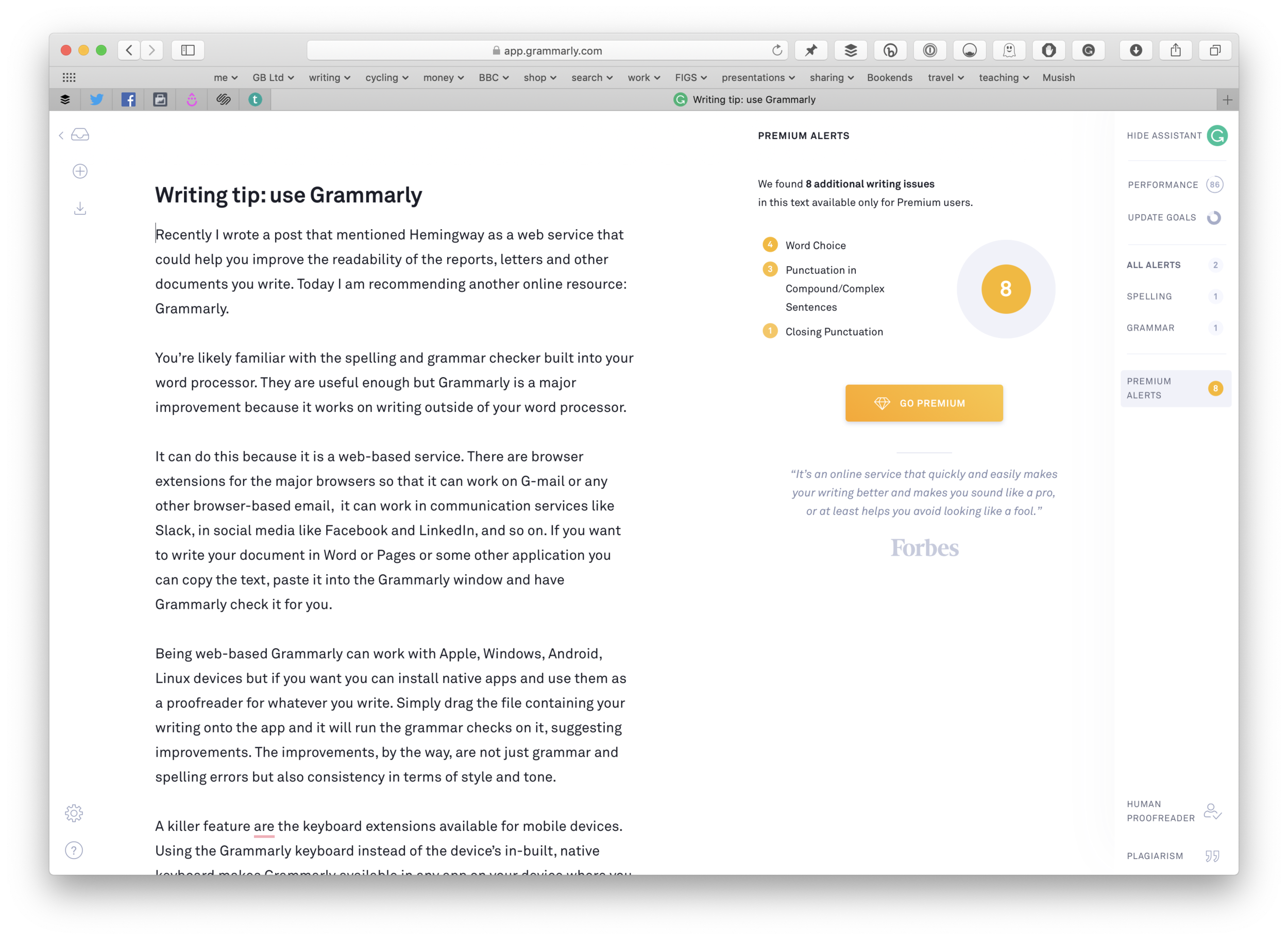
It does more than check grammar and spelling. You can tell Grammarly about your intent for a document, the audience, and some other features and it will take these into account. The image below includes the performance report telling me that the article is better than 86% of articles submitted to Grammarly and that a reader needs at least 9 years of education to understand it.

Being web-based Grammarly can work with Apple, Windows, Android, Linux devices but if you want you can install native apps and use them as a proofreader for whatever you write. Simply drag the file containing your writing onto the app and it will run the grammar checks on it, suggesting improvements. The improvements, by the way, are not just grammar and spelling errors but also consistency in terms of style and tone.
A killer feature are the keyboard extensions available for mobile devices. Using the Grammarly keyboard instead of the device’s in-built, native keyboard makes Grammarly available in any app on your device where you can type. This means you could check the grammar and spelling in text messages, WhatsApp, spreadsheets, etc
Grammarly is a freemium service. The free service is, in my opinion, adequate for most people. The premium level costs $140 a year (a much better deal than the $30 a month if you choose the monthly rate) and for this you get your writing checked against more advanced grammar rules, including sentence structure and style, and a plagiarism checker.
I think the free service is definitely worth checking out. I recommend it to my students when talking to them about writing essays and dissertations but whatever your writing needs it is worth a look. Even if you are a grammar expert you could still find it useful.
If you have a job which involves checking/editing/approving other people's writing you could save yourself a lot of effort by runningtheir words through Grammarly before you even read it. In that kind of situation paying $140 a year is a bargain for all the time you would save.
So, check it out at www.grammarly.com.
If you have any tips to help people write about public money please add them in the comments section.