Help the next generation of women reach their potential
In South Sudan most girls drop out of school early, before they achieve any formal qualifications. In fact, teenage girls are more likely to die in childbirth than complete their secondary education.
At the beginning of February the government of South Sudan published the results of the nationwide primary school leaving certificate which were taken sat at the end of November 2018.
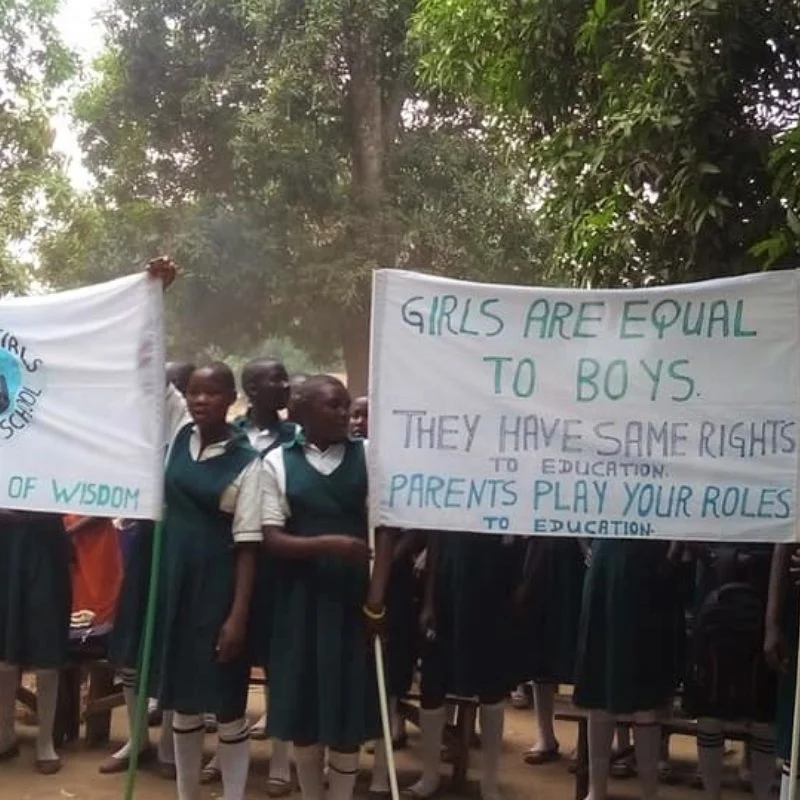
The top scorer in the 2018 examinations was a girl from a small village in the south west of the country. She was joined in the national top ten by five of her classmates. That’s 6 out of the top ten scorers in the country were girls from the same small school: Ibba Girls Boarding School.
In South Sudan most girls drop out of school early, before they achieve any formal qualifications. In fact, teenage girls are more likely to die in childbirth than complete their secondary education.
At the beginning of February the government of South Sudan published the results of the nationwide primary school leaving certificate which were taken sat at the end of November 2018.
The top scorer in the 2018 examinations was a girl from a small village in the south west of the country. She was joined in the national top ten by five of her classmates. That’s 6 out of the top ten scorers in the country were girls from the same small school: Ibba Girls Boarding School. This is a school that opened in 2014 with 40 girls in a single class and 2018 was the first year that its girls were old enough to sit the leaving certificate. It is a remarkable achievement.
The six girls I have mentioned, and the other 29 girls in their class, have now begun the first of the four years that will make up their secondary education.
The school is not only a benefit to the girl pupils. The girls take what they learn home with them to share with their siblings and even their parents. And the school provides employment, with salaries that are reliably paid each month, to more than thirty people. It has a very positive impact on the local community. The national Ministry of Education has noticed this and wants more schools like IGBS across the country.
Ibba Girls Boarding School shows what can be achieved by girls from the poorest of backgrounds if only they have the chance. But the local community cannot afford to run the school — nor can the state education ministry — so the girls rely on funding from the Friends of Ibba Girls School, a British charity of which I am the treasurer (it’s one of the ways I practise what I teach). Here’s a 2-minute video about the school.
If you’ve read this far you won’t be surprised by me asking you to consider supporting the school with a monthly donation. You can find out more about the school, and make a one-off or recurring donation, at our website. If you happen to be involved with an institution that makes grants to a charity like Friends of Ibba Girls School, or know someone who is looking to make a major donation to a good cause, then please email me and we can have a conversation about it.

Become a friend of Ibba Girls School and help girls in South Sudan to finish their education
I am the treasurer of a charity in the UK, the Friends of Ibba Girls School, which exists to build and operate a school for girls in the southwest corner of South Sudan. As well as being the world's newest countries, South Sudan is one of the poorest and most fragile. We all know that education improves the life chances of children and, in practice, their families, too. That's why it is important that Ibba Girls School, and the other schools in the country, exist.
If you have two minutes to spare, here's a video about the school featuring some of the girls whose future we want to enhance.
I am the treasurer of a charity in the UK, the Friends of Ibba Girls School, which exists to build and operate a school for girls in the southwest corner of South Sudan. As well as being the world's newest countries, South Sudan is one of the poorest and most fragile. We all know that education improves the life chances of children and, in practice, their families, too. That's why it is important that Ibba Girls School, and the other schools in the country, exist.
If you have two minutes to spare, here's a video about the school featuring some of the girls whose future we want to enhance.
Building and running a school in South Sudan is not cheap. There are 200 girls currently getting an education at the school and because it is a boarding school, they are also being fed and kept safe as well. As a charity we need to raise GBP25,000 a month to keep the school running. If you want to make us a gift please visit the donation page on our website.

Getting involved with Ibba Girls Boarding School
This story starts in 2002 when I began a Master’s in Public Administration course at Warwick Business School. That’s where I first met Professor John Benington, who at that time was the head of the Institute of Governance and Public Management (IGPM). Fast forward six years ...
This story starts in 2002 when I began a Master’s in Public Administration course at Warwick Business School. That’s where I first met Professor John Benington, who at that time was the head of the Institute of Governance and Public Management (IGPM). Fast forward six years, long after I’d got my MPA, and John sent an email to alumni asking if anyone was interested in helping out with some work the IGPM was doing with the Ministry of Commerce in what was then, prior to independence, the appointed Government of South Sudan. (After more or less 50 years of civil war there was a peace agreement in 2005 which led to a referendum on secession and, ultimately, independence from Sudan in July 2011. South Sudan is the world’s newest country–although I still see lists of countries that do not include it).
In 2008 John had arranged three training courses for 50 civil servants from the Ministry of Commerce to be held in Juba, the capital of South Sudan. This in itself says something: running a course in Warwick Business School would have been more comfortable but only one or two civil servants would have benefited. Taking the courses to South Sudan meant that 50 people got the benefit.
The first two courses that were run were about people management and project management. One of the civil servants was Nagomoro Bridget and she shared her dream with John about building a girls school in the village of Ibba, Western Equatoria, where she grew up.
The third course was in December 2008 and focused on financial management. John’s team for this was Roy Warden from Her Majesty’s Treasury and me. We spent a week at the Juba Bridge Hotel in Juba delivering the course and I remember seeing John pointing out Bridget to me and explaining her dream.
For me, a number of things flowed from that visit to Juba. First, I had an ‘adventure’ by the White Nile (our hotel was just beside the bridge where Levison Wood was arrested whilst Walking the Nile). Second, whilst waiting for a connecting flight at Nairobi airport, John gave me the idea to write a book–a story explained in the foreword. Third, I’d done some work outside of the UK, which was one of my goals when I decided to leave local government and become an independent consultant. Fourth, John saw some potential in me to explain finance to non-financial managers which led to the invitation to teach at Warwick, on the very same MPA course I had taken. And, fifth, I became part of John’s network of supporters for building a girls school in a remote and deprived part of the world.
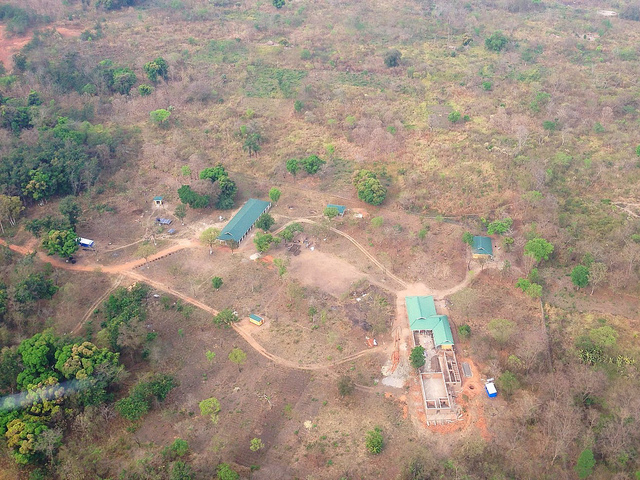
I don’t know exactly when John began actively fundraising for Ibba Girls School but through 2009 and 2010 he was mobilising people in his network, first informally but ultimately through a registered charity, Friends of Ibba Girls School. After a few years of fundraising work started on the school (on 73 acres of land Bridget had inherited from her father) in 2012 and the school opened with a class of 40 girls in Mach 2014. During this time I was an occasional advisor helping with some of the financial planning but I was not formally a trustee of the charity. I was also a supporter in a small way, reading the monthly newsletters and keeping in touch with progress and John’s regular trips to Ibba. (As of last week he has made 21 trips to South Sudan in 7 years.)

In April 2014 John rang me to ask me three questions. I can’t remember what the first two of them were but the third was, would I consider being the treasurer when the existing treasurer stepped down in the autumn? After years of persuading people to help with the Ibba Girls School project John is a difficult man to turn down, not that I ever though of saying No. My concern was just about limiting my time commitment because this is the sort of project that can become full time if one lets it.
My intention was to be a light touch treasurer, keeping an overview of the charity’s bank balances and giving a report to each of the quartlerly meetings. From the viewpoint of the summer of 2014 that looked achievable. Since then, at my first meeting as a trustee, I learned that Jamie, the volunteer who had been managing the school’s finances, and much else besides, had decided to return to his native Australia. This meant I would have to get involved in recruiting a replacement, something which is not easy from 3,800 miles away (which will be the subject of a separate blog post). Ultimately that resulted in me travelling to Ibba at the beginning of this month to finalise the appointment of a local man, Santino, and begin to train him. His training and support will continue over the next few months by email and Skype.
Perhaps I was kidding myself that I could be the treasurer of a charity in a light touch way. Certainly for the next few months I think it will take up one day a week of my time. I don’t mind, though, because I’ve been to the school and I’ve seen the girls in a classroom. Everyday that they are in school they are safe, they are fed and they are learning. That’s worth it.
If you want to know more about the Friends of Ibba Girls School and its work, and if you would like to make a donation, please look at the website. You can also look at a gallery of photos I took during my visit over on Flickr.
Will fraud increase because of austerity?
The UK was ranked 17th in the 2012 edition of Transparency International's Corruption Perceptions Index. Having heard Professor Alan Doig at the recent CIPFA Audit Conference I wonder if we may slip down the ranking over the next few years. Prof Doig is undoubtedly an expert in fraud and corruption and has applied his knowledge around the world. His friendly, wryly-humoured delivery belied what I thought was a rather bleak message. In fairly short order he demonstrated how much of the UK's public sector anti-fraud apparatus has been, or soon will be, demolished:
- only 25% of police forces have fraud squads
- only one force (West Midlands) out of 43 has anyone looking at election fraud
- the Audit Commission will be abolished.
These changes come at a time when more and more public money is being moved outside of the traditional accountability structures. So, for example, a local authority's rules apply to its schools and they would be subject, amongst other things, to visits from the internal auditors. We've already seen financial management problems at academies, such as this example in London. What arrangements will apply to free schools which seem to me to be even further outside the traditional accountability arrangements? Another example: our traditional approach to providing personal social care has been for local authorities to assess needs, commission someone to provide care and then pay the bills. Increasingly individuals are being given more control of their care. After their needs are assessed they receive a direct payment from the local authority and they arrange their care and pay for it. I can see the benefits to individuals of this approach but it introduces the potential for the misapplication of the money. Surely taxpayers and the local authority need new accountability mechanisms to cover this element of public spending?
One comment made by Prof Doig has stuck in my mind: on average only 30% of fraudsters are detected. If that is the rate when we've got a lot of anti-fraud work in place what will the detection rate be in the future?
High volume, low value frauds, he said, pose a particular problem. Fraudulent claims of social security benefits have long been an issue in the UK (the Department for Work and Pensions has worked hard to get the rate down to less than 2% but it still amounts to about £2billion a year, and consequently their accounts have been qualified every year for more than two decades).
Perhaps a strategy for public bodies is to carry out a risk assessment and focus the resources on areas where the potential payback is best. When asked about this, Prof Doig identified housing tenancies and direct payments for personal social services as areas to focus on.
It's understandable that public bodies which are under pressure to reduce their expenditure have reduced the level of resources applied to preventing and detecting frauds. But it's just like cutting training. It may be understandable but we all know that in the long run it will cost us more money. To borrow a quotation from Peter Senge, "The easy way out usually leads back in."
I started this post by pondering whether the UK will fall in the CPI. That index is a relative measure so the UK's position depends also on what other countries do. I would be interested to hear if comments about whether other countries are breaking up their anti-fraud infrastructure in the way that the UK is.
UPDATE
Since I wrote this article the National Fraud Authority has published the Annual Fraud Indicator report for 2013. They estimate fraud in the public sector amounts to £20.6billion, which is of the order of 3% of total annual public spending.