
All public managers should manage contracts
Choose a public service organisation — it could be where you work or your local government or a major hospital — and I will bet you that the number of human resources professionals is greater than the number of procurement professionals. Not only that, it will be far out of proportion with the split of the budget between employee and non-employee expenses. Why is that?
Choose a public service organisation — it could be where you work or your local government or a major hospital — and I will bet you that the number of human resources professionals is greater than the number of procurement professionals. Not only that, it will be far out of proportion with the split of the budget between employee and non-employee expenses. Why is that?
An example
Let me use myself as an example. My CIPFA professional qualification course included general theories about management but it was mostly about accounting and trained me to be an accountant and not a manager. Therefore, after qualification, I went through the whole management development process as part of my professional development. I did management courses on recruitment, leading a team, equalities and diversity, disciplinary procedures and communication. I also did some skills-based training on things like report writing and presentations. What I didn’t do was any training in connection with procurement, contract management and negotiation skills. In fact, I don’t think those courses were available to me.
As it happened, almost immediately after I qualified I became involved in an outsourcing project and other outsourcing projects happened fairly regularly throughout the 20 or so years I worked as an public sector accountant. I learned, therefore, about procurement and contracts from the lawyers and procurement professionals I worked with. Whilst this is great on-the-job training, if I had been assigned to some different tasks and projects as a newly qualified accountant I never would have learned this stuff. I doubt, though, that it would have stopped me becoming a finance director because it was never on a person specification or asked about in an interview
Does it matter?
I think this matters. I think weak contract management skills is an under-recognised problem.
The Open Contracting Partnership’s 2020 Annual Report estimates that public contracts amount to $13 trillion a year. That is something like 15% of the world’s total GDP and about half the total spending by governments. The proportion of government spending through public contracts will vary between countries and programme areas, but it is clear that procuring and managing contracts needs to be a significant component of the work done by public managers.
I think the senior managers in an organisation need to know how to manage contracts and suppliers given the proportion of spending that is not an employee spending. I find it very hard to believe that senior private sector managers get their jobs without having experience of managing contracts and suppliers.
I think that if an organisation’s managers know nothing about contract management and supplier relationship management then they do not know the good from the bad, they do not know if their organisation is good or bad at managing its suppliers. That has to be an issue.
What should be done?
Actually I don’t think the answer is for public sector organisations just to recruit a mass of qualified procurement professionals and hope that fixes things. What I think needs to happen is more subtle than that. I think public managers need their training and development to encompass the provision of public services through outsourced suppliers just as much as through direct employees. They should continue to have their training in recruitment and diversity and so on; but they should also have training in the parallel arts of procurement, contract management, and supplier relationship management.
This applies to public finance professionals just as much as to public managers in general. Public finance professionals can play a positive role through the whole contract life-cycle. They can help in the procurement phase; they need to understand contracts in order to give advice during the delivery phase of a contract, and how it affects the budget. If things go wrong then public finance professionals can help with the exit from the contract and its replacement with an alternative supplier or even the direct provision by the public organisation.
None of these things will happen by accident. I think the professional accounting syllabuses need to incorporate procurement, contract management and negotiation as key skills for finance professionals. I think they could also encourage their students to adopt a more commercial approach in their thinking so they can understand suppliers better.
More generally, a good starting point for any organisation would be to analyse how much of its activity is done by direct employees and how much by contractors and train its managers to match.
Let me be your guide to public financial management
I have written and produced a [new online course]. It’s called Introduction to Public Financial Management and is aimed at anyone working in government or public sector organisations.
I have written and produced a new online course. It’s called Introduction to Public Financial Management and is aimed at anyone working in government or public sector organisations.
Completing the course will enable you to:
Understand the public finance management cycle.
Manage a budget for a project, service or organisation.
Understand the sources of funding available to governments and their relative strengths and weaknesses.
Understand the importance of creating value for money and how to measure it.
Know when it makes sense to involve a partner in the delivery of a project or service, and how to get the best from the partner.
Know how to evaluate investments and projects.
I created the course in partnership with FreeBalance, the government software company. They have been developing a portal for online learning — the FreeBalance Academy — and invited me to contribute my own courses to it. I took the opportunity to make an online version of the course I teach at the University of Nottingham.
The course has ten units, each aligned with a chapter of my book. Unlike a book, this course is interactive. There are more than 60 videos and a whole host of other resources including downloadable documents and quizzes to test your learning. And if you pass the final assessment at the end there is a certificate of completion.
Find out more, and register, by clicking the button below.

The principles of public procurement explained in under an hour
I wrote a short e-book that explains the principles of public procurement by using the hiring of a consultant as an example. The book will take less than an hour to read and yet it includes an explanation of the key steps in the process and has links to additional resources to help with writing your specification (get this wrong and the chances of things going wrong increases dramatically) and managing suppliers.
It used to be the case that 75% or 80% of public money was spent on salaries and wages but for many public bodies that has fallen to 50% or lower. This is because public bodies now do less of their work directly and buy in services from third parties.
Knowing how to procure a service and then manage the service provider is an important set of skills for the modern public sector manager. Modern managers get plenty of training in how to interview job candidates, leading teams, managing employee performance, etc but but in my experience many they rarely receive any training in the equivalent activities for suppliers rather than employees.
To help such managers I wrote a short e-book that explains the principles of public procurement by using the hiring of a consultant as an example. (As far as procurement goes the consultant could be any kind of advisor such as an architect, an IT expert, an interim manager, etc.) The book will take less than an hour to read and yet it includes an explanation of the key steps in the process and has links to additional resources to help with writing your specification (get this wrong and the chances of things going wrong increases dramatically) and managing suppliers.
To get the e-book — did I say it’s free? — click here.


How to Hire a Consultant in the Public Sector — the e-book
Over the last couple of weeks I’ve been working on a small e-book about procurement in the public sector as a learning exercise. This is not learning how to write a book, but how to get a manuscript formatted as an e-book, with a cover, etc and uploaded to a platform for sale. It turns out that it is fairly easy to do but, like many things, the first time you do it takes a lot longer.
Over the last couple of weeks I’ve been working on a small e-book as a learning exercise. This is not learning how to write a book, but how to get a manuscript formatted as an e-book, with a cover, etc and uploaded to a platform for sale. It turns out that it is fairly easy to do but, like many things, the first time you do it takes a lot longer.
I wrote an e-book about procurement in the public sector, using the example of hiring a management consultant or advisor. I did this because it seems like the sort of thing a manager might do in pretty much any part of the public sector. Schools, hospitals, local councils, police forces, etc will all use advisors from time to time and they all have to follow the same process in broad terms. What I mean is, they all need a specification, a tender or quotation process, an evaluation, and an award process even if all of them have their own specific rules. They also all need to manage the consultant once appointed, an aspect often overlooked.
I wrote the manuscript in an app called Ulysses because it allows you to write your text as plain text but export it in many formats. One of the export formats is epub which happens to be one of the formats that Apple’s iBookstore can handle. As an Apple nerd I wanted to make the book available as an iBook even though the sales potential in the iBookstore is very limited. (Let’s face it, first you have to have Apple hardware and then you have to be interested in a niche subject!)
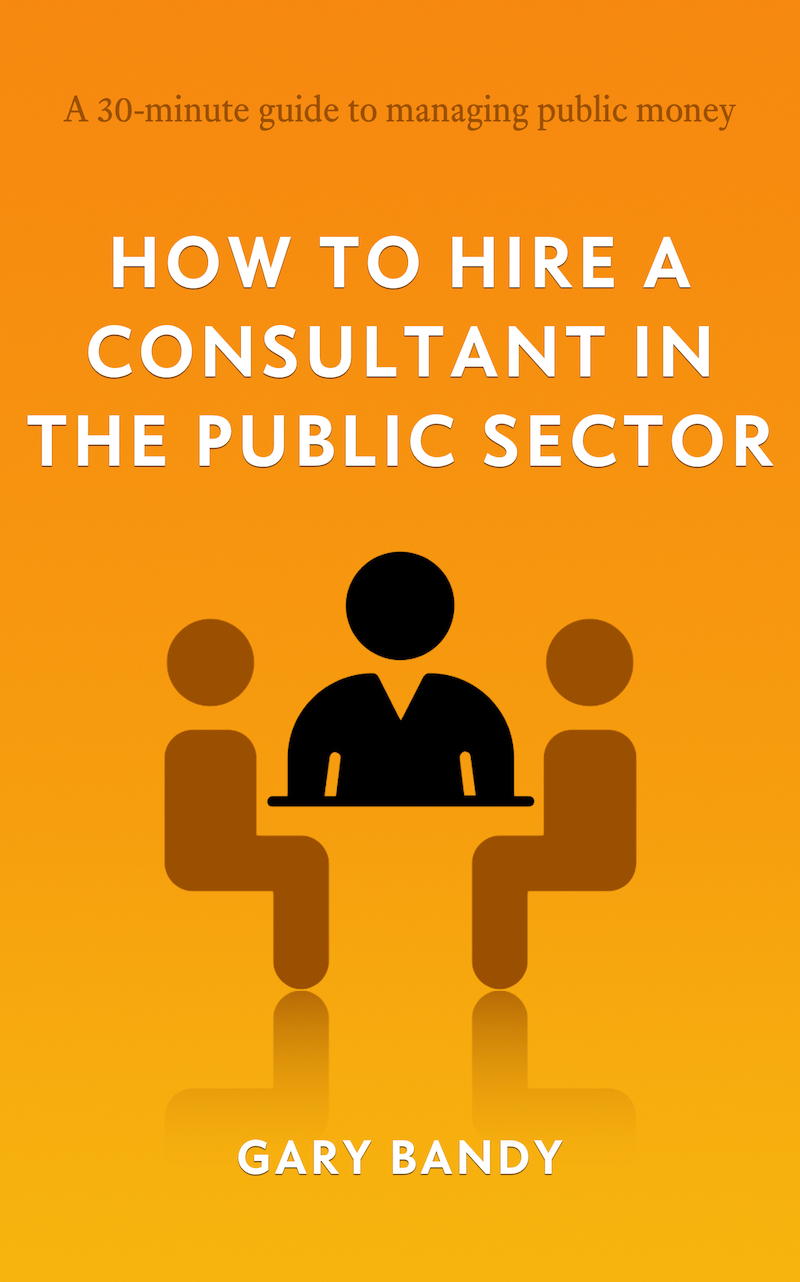
Before I could export the epub from Ulysses I had to create a cover. I could have commissioned an artist to create a cover for me but that would cost potentially more money than I might make from this test book so I made my own. I’m not a great graphic artist but I know a bit about using an app like Pixlmator so that’s how I created the cover you can see below.
Once I had a cover I had to incorporate it into the export function in Ulysses and, bingo, I had an epub file.
Amazon Kindle does not support epub files so I then had to run my epub file through an app called Kindle Previewer in order to convert it into the mobi file type that Kindle does support.
The next part turned out to be the hardest and longest step in the whole process. I thought I would be able to use my accounts with iTunes and Amazon to upload the files and click a few buttons to add prices etc and that would be that. It is sort of like that except the first time you need to get yourself an American tax identification number in order to benefit from the tax treaty between the UK and USA. As American companies Apple an Amazon would hold back 30% tax from any royalties that I earn unless I registered with the IRS and claimed an exemption under the tax treaty. On that basis they would withhold 0% tax and I would have to pay only the UK tax on the income. That took a fair bit of research, the completion of a form, a long phone call to the IRS to explain what I was doing, etc. To be fair, at the end of the call I was given my ID number and could use it directly in the Amazon and iTunes set up pages.
After that is is more or less a case of uploading the file, entering meta data, marketing blurb, pricing information and a publication date and the book will be published.
If you are interested in reading this book about public sector procurement click on the following links to get it from Amazon or the iBookstore.
Will a strategic partnership save money for a police force
Last week I gave a short presentation to the joing national conference of the Police Authority Treasurers Society and the Directors of Finance of police forces. I have helped the police in Lincolnshire and West Midlands with the procurement of strategic partnerships but this talk was not about those projects. Instead I was commissioned to talk about the pros and cons of having a strategic partnership. I hope I achieved that. One treasurer said to me afterwards that is was "as balanced an exposition of the issues of outsourcing" as he'd heard. I guess that means I did what was asked of me.
I've posted the slide presentation on Slideshare.net and they are embedded below. They give a flavour of what I spoke about but I like to think that you get more from a presentation when I'm presenting it than from looking at the slides in isolation. So if you want to know more about this subject please feel free to get in touch with me.